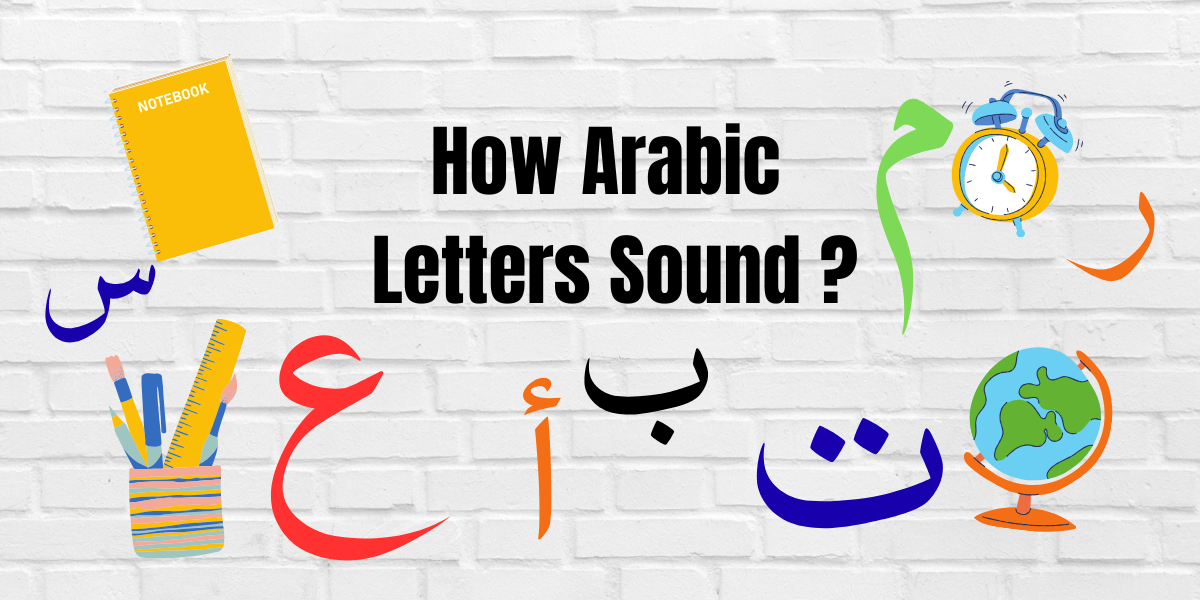
How Arabic Letters Sound ?
When you start learning Arabic, the first thing you meet is its letters. They look different, sound different, and feel different when you try to pronounce them. Each one has its own place in your mouth and its own way of being produced. Arabic is built on sounds that carry meaning and emotion, and understanding them is the key to understanding the language itself.
Arabic has 28 letters. Each one represents a unique sound. Some of these sounds exist in English or other languages, but many do not. This is what makes Arabic pronunciation both fascinating and challenging for learners. To speak Arabic correctly, you need to train your ear, your tongue, and even your breath. You cannot just read Arabic; you must hear it and feel it.
Many learners begin Arabic thinking it will be like learning any other language, but soon they realize the sounds demand a new level of attention. Letters like خ (kh), ع (‘ayn), or غ (gh) have no true match in English. They come from deep inside the throat. You do not just pronounce them; you produce them. This is why pronunciation is not just a small part of Arabic. It is the foundation.
Arabic letters are not only symbols. Each one has a story, a history, and a connection to how the language developed over centuries. The way you pronounce a letter changes the meaning of a word completely. For example, ح (ḥa) and ه (ha) may look or sound close to a beginner, but they carry very different meanings. If you confuse them, you might say “dream” instead of “day” or “love” instead of “sin.” This is why mastering pronunciation is not optional; it is essential.
The beauty of Arabic is that its letters are logical once you understand how they work. The sounds come from five main parts of the mouth and throat:
- The lips
- The tongue
- The middle and back of the mouth
- The throat
- The nasal area
Every Arabic letter has a makhraj—a specific point of articulation where the sound begins. This concept is ancient. Early Arabic scholars studied how sounds were produced and documented them in great detail. They were among the first in the world to describe the science of phonetics. When you learn Arabic letters, you are learning a system that has been studied and perfected for over a thousand years.
But Arabic pronunciation is not only about science. It is also about rhythm and balance. Each sound has weight and length. Some letters are heavy, others light. When you read or speak Arabic, you can feel this balance in every word. It gives the language its unique musical quality. The Quran, classical poetry, and even modern songs all rely on this sound structure. That is why pronunciation carries cultural and spiritual importance too.
For non-native speakers, one of the biggest challenges is hearing the small differences between similar letters. For example:
- س (seen) and ص (ṣaad)
- د (dal) and ض (ḍaad)
- ت (taa) and ط (ṭaa)
At first, they might sound the same. But when you listen carefully, you notice one is lighter and the other heavier. You learn to use your tongue in a slightly different position. Over time, your mouth adapts. Arabic pronunciation is a skill you build through listening and repetition. Like learning music, it requires practice, patience, and the willingness to sound strange at first.
Many students feel shy or embarrassed when trying to pronounce these new sounds. But that is a mistake. Making mistakes is part of the learning process. Every native Arabic speaker once learned to control their tongue and throat to make these sounds as children. As an adult learner, you go through the same process, but more consciously. You must listen carefully, imitate, and repeat until it feels natural.
Arabic pronunciation also connects you to people. When you pronounce words clearly and correctly, native speakers can understand you more easily. They see your respect for the language and its culture. This creates trust and appreciation. It opens doors to real communication.
Learning how Arabic letters are pronounced is not about perfection. It is about clarity and confidence. You do not need to sound like a native speaker on your first day. What matters is that you know where the sounds come from and you train your mouth to produce them. Once you master that, reading, writing, and speaking Arabic become much easier.
At Ramdani Arabic Academy, we teach Arabic pronunciation as a living skill. Our goal is to make every learner hear and feel the sounds as Arabic speakers do. Whether you are learning for travel, study, or faith, mastering pronunciation will change the way you experience the language. It is the first real step toward fluency.
Arabic letters are more than symbols. They are the bridge between sound and meaning, between culture and expression. When you learn how to pronounce them, you are not only learning a language—you are joining a centuries-old tradition of speech, poetry, and knowledge.

The Sounds of Arabic Letters
Arabic pronunciation is built on precision. Every letter has a fixed position in your mouth or throat. Once you know these positions, you can produce every Arabic sound correctly. The system is organized and logical. Arabic scholars call this science Tajwīd when used for Quranic recitation and phonetics when applied to general speech.
Arabic has 28 main letters. They are grouped based on where the sound is produced. These are called makhārij al-ḥurūf — the points of articulation. Learning them helps you know exactly how to move your mouth and tongue.
1. Throat Letters
Six Arabic letters come from the throat. They are ء (hamzah), ه (ha), ع (‘ayn), ح (ḥa), غ (ghayn), and خ (khā’).
- ء (hamzah) is a sharp sound that stops the air for a moment, like the break in “uh-oh” in English.
- ه (ha) is a soft breath sound, similar to “h” in “hello.”
- ع (‘ayn) is unique. It comes from deep inside the throat. You contract your throat slightly and push the air upward.
- ح (ḥa) is a stronger, breathier sound than “h.” It feels like warm air leaving your throat.
- غ (ghayn) is voiced; it vibrates. It sounds like the French “r” in “rue.”
- خ (khā’) is unvoiced; it comes from the same place as “gh,” but without vibration. Like the Scottish “loch.”
Most learners find these letters difficult because they do not exist in many other languages. To master them, record yourself and compare your pronunciation to native speakers. You will feel progress as your throat muscles adapt.
2. Tongue Letters
The tongue produces most Arabic sounds. It moves from the tip to the back to create fourteen different letters. Here are a few examples:
- ت (taa), د (dāl), and ط (ṭā) are from the front of the tongue touching the upper teeth.
- ر (rā) rolls lightly with a tap of the tongue.
- س (sīn), ز (zayn), and ص (ṣād) come from air passing between the tongue and upper teeth.
- ض (ḍād) is special. It comes from one side of the tongue touching the upper molars. No other language has it. Arabs even call their language “Lughat al-Ḍād” — the language of Ḍād.
- ك (kāf) and ق (qāf) are produced at the back of the tongue. “Kaf” is lighter, “Qaf” is heavier and deeper.
You can train your tongue by exaggerating these positions slowly, then reducing the effort once your muscles remember the motion. This method helps develop accurate pronunciation.
3. Lips Letters
The lips produce four letters: ف (fā), ب (bā), م (mīm), and و (wāw).
- ف (fā) is like English “f.”
- ب (bā) is like “b,” but with stronger closure of the lips.
- م (mīm) is the “m” sound, nasal and clear.
- و (wāw) works both as a consonant (“w”) and as a long vowel (“oo”).
These are the easiest letters for most learners. Focus on controlling air and sound together. Clear lip movement makes your speech precise and smooth.
4. Nasal and Mixed Sounds
Two letters involve the nose: م (mīm) and ن (nūn). The air passes partly through the nose when you say them. Native speakers often hold these sounds slightly longer in reading or recitation. You can practice by closing your nose while saying “m” or “n.” If you feel pressure, you are using the correct nasal passage.
5. Emphatic (Heavy) Letters
Arabic also has letters called tafkhīm (heavy letters). These are خ (kh), ص (ṣ), ض (ḍ), ط (ṭ), ظ (ẓ), and غ (gh), and ق (q).
When you pronounce them, your tongue raises slightly toward the roof of the mouth. The sound becomes broader and deeper. These letters affect the vowels around them too, giving Arabic its distinct resonance.
To feel the difference, say س (seen) and ص (ṣād).
“Seen” sounds light, like the English “s.”
“Ṣād” sounds deeper, as if it fills your mouth.
Switching between light and heavy letters is one of the marks of correct pronunciation. It gives Arabic its rhythm and balance.
6. The Role of Vowels
Arabic has short and long vowels. Short vowels are not written as letters but as marks above or below letters:
- َ (fatha) – short “a”
- ِ (kasra) – short “i”
- ُ (damma) – short “u”
Each can be stretched into a long vowel using letters:
- ا (alif) for long “aa”
- ي (ya) for long “ee”
- و (wāw) for long “oo”
These vowel sounds change meaning completely. For example, كتب (kataba) means “he wrote,” while كُتِبَ (kutiba) means “it was written.” The difference is small in sound but large in meaning.
Practice and Listening
The best way to master Arabic pronunciation is through imitation. Listen to native speakers often. Repeat what they say slowly. Focus on how your mouth moves, not only the sound you hear.
Record your voice. Compare it with original recordings. Adjust your position of the tongue, lips, and throat until it matches.
Every Arabic letter is a movement. Once your muscles memorize those movements, your pronunciation becomes natural. That is when you start hearing Arabic not as separate sounds but as one connected system.
Arabic pronunciation is not only about speaking clearly. It is about hearing precisely. The more your ear trains to recognize details, the faster you improve.

Connecting Letters and Mastering Pronunciation
Arabic letters change shape depending on their position in a word. They can appear at the beginning, middle, or end, and sometimes stand alone. The sound stays the same, but the written form adapts. This feature often confuses new learners, yet once you understand it, reading becomes easier and more logical.
Each letter in Arabic connects smoothly to the next, forming a continuous flow. Unlike English, which separates letters, Arabic writing moves like a line of sound and meaning joined together. Learning how to connect these letters visually helps you pronounce words naturally.
For example, take the word كتاب (kitāb) — meaning “book.”
- ك (kaf) starts the word
- ت (taa) follows
- ا (alif) stretches the vowel
- ب (baa) ends the word
When you read it out loud, each letter connects not only in writing but also in sound. The rhythm is steady, and the movement of your tongue matches the visual connection of the letters. This is one of the reasons Arabic sounds so fluid when spoken correctly.
Common Pronunciation Mistakes
Most learners share the same pronunciation problems. These come from the differences between Arabic and other languages. Recognizing these mistakes early helps you correct them before they become habits.
- Mixing heavy and light letters
Learners often pronounce heavy letters like ص (ṣ) or ط (ṭ) too softly, or light letters like س (s) and ت (t) too heavily. This changes meaning and sound balance. To correct this, exaggerate the heaviness or lightness when you practice. Over time, your ear will recognize the difference. - Ignoring the throat sounds
Letters such as ع (‘ayn), غ (gh), and خ (kh) require throat control. Many learners replace them with simple sounds like “a” or “h.” That makes the word understandable but not accurate. You need to feel the vibration or pressure in your throat when you say them. - Short vowels confusion
Arabic uses short vowels that are not written as letters. Beginners skip or misplace them, leading to wrong pronunciation. For example, كتب (kataba) means “he wrote,” while كتَب (kutiba) means “it was written.” Listen carefully to vowel length and stress; even a small change can shift the meaning. - Weak letter connection
When reading words, some students pause between letters. Arabic does not work like that. The language depends on flow. Practice reading short words slowly but without breaks. Join the letters with your tongue as you see them connected on the page. - Flat intonation
Arabic has rhythm. It rises and falls naturally. When learners speak too flatly, it sounds unnatural. Listen to native speakers and copy their tone patterns. Focus not only on what they say but how they say it.
How to Correct Pronunciation Step by Step
Improvement in Arabic pronunciation is a physical process. Your tongue, lips, and throat must train like muscles. The following steps help you move from confusion to clarity.
- Listen before speaking
Start every new lesson by listening to native Arabic. Choose short recordings of words or sentences. Listen several times until you can recognize each letter’s sound. - Isolate difficult sounds
Focus on one problem sound at a time. For example, if ع (‘ayn) is difficult, repeat it in isolation before using it in words. Say it slowly. Feel where it begins. Then place it inside words like علم (‘ilm) or عمل (‘amal) until your mouth adapts. - Use mirror practice
Watch your mouth move while speaking. Many letters depend on lip or tongue position. Seeing yourself helps you control these positions consciously. Over time, the correct form becomes automatic. - Record and compare
Record your voice reading short Arabic sentences. Play it next to a native recording. Identify the differences in tone, rhythm, or articulation. Focus on fixing one small area each time instead of trying to correct everything at once. - Read aloud daily
Consistency is more important than long study sessions. Five minutes of focused pronunciation practice daily gives faster results than one long session once a week. Read short texts, even children’s stories or Quranic verses, to build rhythm and confidence. - Use slow repetition
Repeat each word slowly, then faster, until your pronunciation stays consistent. This trains both your memory and muscle control. You can also clap or tap lightly while pronouncing each syllable to keep your rhythm steady. - Learn with feedback
No one perfects Arabic pronunciation alone. You need feedback from a teacher or native speaker. They hear small differences you may not notice. At Ramdani Arabic Academy, we emphasize direct feedback in our pronunciation sessions. Each correction builds your confidence and accuracy.
Connection Between Sound and Meaning
Arabic pronunciation carries meaning beyond words. The language’s sounds express emotion, strength, and precision. When you pronounce letters clearly, you feel their impact. Words like سلام (salām), حب (ḥubb), or نور (nūr) carry peaceful and rich tones because of their sound structure.
Your pronunciation reflects your understanding of the language. Clear sounds show clear knowledge. The more accurate your speech becomes, the more confident you feel using Arabic in conversation, study, or travel.
Arabic pronunciation is not about speed but about control. Speak slowly. Respect each sound. The goal is not to imitate but to internalize. Once you control the letters, you control the language.

Practical Guidance
Arabic pronunciation is more than repeating sounds. It is the skill that transforms learning from memorizing to understanding. When you can pronounce each letter correctly, you can hear the meaning clearly, read faster, and speak with confidence.
Every Arabic learner struggles at first. That is normal. The letters feel new, the throat feels tight, and the tongue moves differently. What matters is not how fast you learn but how consistently you practice. Arabic pronunciation rewards discipline. Small daily effort brings clear progress.
Build a Routine
Create a short routine focused only on pronunciation. Ten minutes a day is enough if you repeat the right way.
Try this simple plan:
- Start by listening to one native speaker saying a short sentence.
- Repeat each word slowly.
- Focus on the position of your tongue and lips.
- Record yourself.
- Play both versions and compare.
- Correct the differences.
You do not need to study everything at once. Pick two or three difficult letters each week and master them. Once you control those sounds, move to the next group. Arabic pronunciation improves one letter at a time.
Use the Right Resources
Choose clear, reliable recordings. Avoid sources where pronunciation is mixed with dialects until you understand Modern Standard Arabic. Dialects can wait. Build your foundation first. Use tools that show the mouth and throat positions. Visual guidance helps you correct your technique faster.
If you have access to native speakers, ask them to repeat words slowly for you. Notice the rhythm and sound changes when they speak naturally. Arabic has a beat; every word fits that beat. When you catch it, your pronunciation flows.
Train Your Ear
Your ear is as important as your tongue. Spend time listening without speaking. Focus on how letters change in connected speech. Many learners try to speak too early and miss this stage. Good pronunciation begins with deep listening.
When you hear native speakers, pay attention to the difference between short and long vowels. Arabic sound length changes meaning. If you stretch or shorten a vowel incorrectly, the word changes. Practice this by reading verses, poems, or short sentences that repeat patterns of sound.
Be Patient and Consistent
Arabic pronunciation takes time because it trains new muscles. You may feel frustrated when your ع (‘ayn) or غ (gh) does not sound right, but every repetition strengthens your control. Think of it as physical training. Your throat and tongue are learning coordination.
Make pronunciation practice enjoyable. Read words that interest you. Say names, cities, or phrases you like. Connect emotion to the sound. When you feel meaning, the sound stays longer in memory.
Why Pronunciation Matters
Correct pronunciation does more than help you speak. It improves your listening, reading, and writing. It allows you to understand native speakers without relying on subtitles or translations. It shows respect for the language and its speakers. It turns Arabic from a set of letters into a living system you can use and enjoy.
Learners who invest early in pronunciation learn faster later. They read more accurately, spell better, and develop stronger comprehension. This is why every serious student must give time to pronunciation before anything else.
Ramdani Arabic Academy
At Ramdani Arabic Academy, we believe clear pronunciation is the foundation of every Arabic skill. Our lessons focus on hearing, speaking, and feeling the sounds of Arabic from the first day. Each course combines structured exercises with live practice. Students learn how to move their tongue, lips, and throat correctly while understanding the meaning behind every sound.
We teach learners from around the world — students, professionals, and language lovers — who want to use Arabic confidently. Our method is practical and focused on results. Each learner receives feedback based on their level and accent. Over time, they speak Arabic clearly, naturally, and without fear.
We also publish articles and resources to help learners study independently. Our goal is to make Arabic accessible to anyone who is ready to learn with patience and discipline. Whether you want Arabic for work, travel, or spiritual study, pronunciation is where your journey begins.
About the Author
Ramdani Mohamed is the founder of Ramdani Arabic Academy. He teaches Arabic to non-native speakers through online courses, private sessions, and written materials. His approach combines traditional phonetic science with modern teaching methods. He believes pronunciation is the bridge between learning Arabic as theory and living it as communication.
Ramdani started teaching after seeing how many learners struggled with pronunciation and lost confidence early. His mission is to make Arabic clear, logical, and enjoyable for every student, regardless of background. Through his academy, he continues to help learners build real fluency step by step.
Final Thoughts
Arabic letters are more than sounds. They are the voice of a language that has shaped culture, literature, and knowledge for centuries. When you learn to pronounce them correctly, you connect to that heritage.
Your success depends on three things: attention, practice, and patience. Listen carefully. Repeat daily. Accept mistakes as part of learning. Over time, your ear sharpens, your speech smooths, and Arabic becomes part of how you think.
Pronunciation is not the end of learning; it is the beginning. Once you master it, everything else in Arabic becomes easier. You read with understanding. You write with confidence. You speak with meaning.
That is the power of learning how Arabic letters are pronounced.