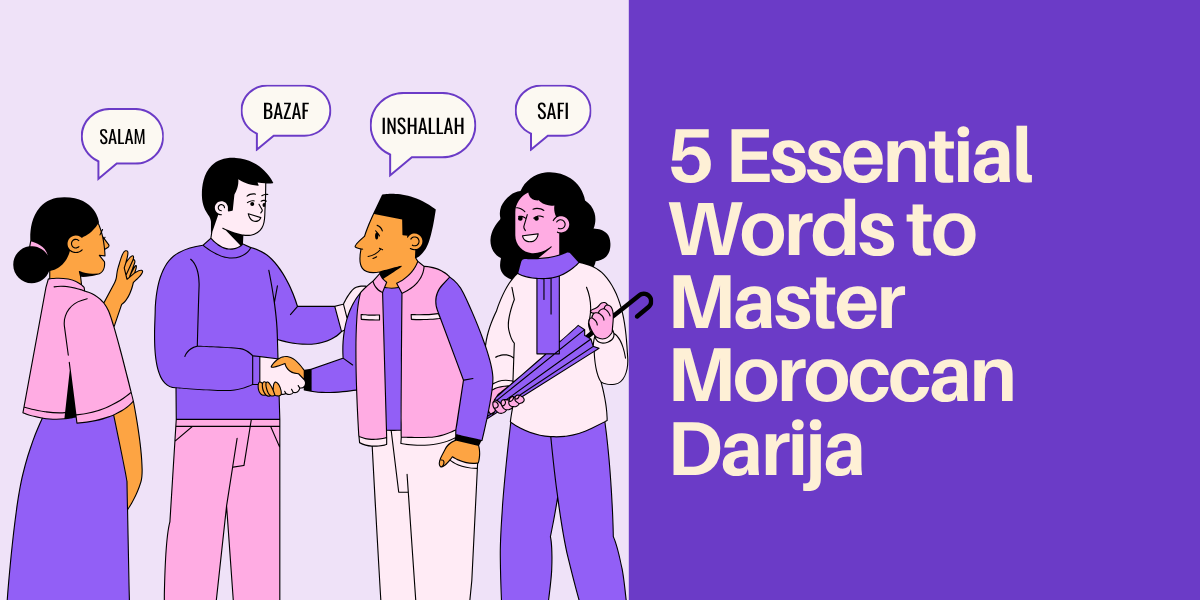
5 Essential Words to Master Moroccan Darija
When people think of Arabic, they often imagine the language spoken in news broadcasts or classical texts. But once you travel to an Arabic-speaking country, you realize that every region has its own version of Arabic, full of local sounds, expressions, and rhythm. Among them, Moroccan Darija stands out. It is fast, colorful, and filled with unique words that carry the spirit of Morocco itself.
Moroccan Darija is not a separate language, yet it feels like one. It is a mix of Arabic roots with Amazigh, French, and even Spanish influence. For a learner who already knows Modern Standard Arabic, the first reaction is usually surprise. The structure feels familiar, but the words sound completely different. The pronunciation is sharp, and the speed of speech makes it seem impossible to follow. But once you begin to understand it, Darija becomes one of the most expressive and lively varieties of Arabic you can learn.
In Morocco, Darija is not just spoken on the streets. It is the language of home, friends, humor, and everyday life. It is how people connect with each other. Standard Arabic is used in school, news, and formal writing, but Darija lives in music, conversations, and jokes. If you want to truly connect with Moroccans, you have to learn their Darija. It’s how you understand what’s behind their words, their humor, and their warmth.
Many learners of Arabic think they should master Modern Standard Arabic first, and they are right. But if you plan to visit Morocco, live there, or even just speak with Moroccan people online, you need to learn at least the basics of Darija. It is not only about communication. It’s about understanding a unique culture, a different way of using Arabic that evolved through history and geography. Morocco’s position between Africa and Europe created a language that reflects centuries of cultural exchange.
When you hear Moroccans talk, you’ll notice they switch between Darija, French, and Standard Arabic with ease. This language flexibility makes Moroccan society dynamic. It also makes learning Darija more interesting, because every word you learn carries traces of another culture. For example, some Darija words come from Amazigh languages, the native languages of North Africa. Others come from French, due to Morocco’s colonial past. You might even hear Spanish words in the northern regions. The result is a dialect that feels like a living history book.
At first, many learners feel intimidated by Darija. They search for textbooks or online courses and realize there are not as many resources as for Modern Standard Arabic. This is changing now. More teachers, content creators, and academies are starting to share lessons, dialogues, and videos. That is one of the reasons we created Ramdani Arabic Academy—to make Moroccan Arabic accessible to learners everywhere, to explain it clearly, and to make it easier to practice.
Learning Moroccan Darija gives you more than vocabulary. It gives you access to Moroccan culture. When you understand even a few words, you can enjoy Moroccan songs, follow local TV shows, and connect with people more naturally. Imagine visiting a Moroccan market and greeting a seller in Darija. You will see an instant smile. Language creates trust and friendship. That’s what makes learning Darija worth it.
Another reason to learn Darija is its growing presence online. Moroccan creators on YouTube, TikTok, and Instagram use Darija every day. Their content reaches millions of people. If you understand Darija, you open a new world of media, humor, and modern expressions. It’s a language that grows and changes daily, shaped by the new generation. Learning it keeps you connected to how Arabic is really used by people in their lives.
In this article, we will focus on five important words in Moroccan Darija that every learner should know. These words are simple but powerful. They appear in daily conversations and help you sound more natural. They are also a good starting point to understand how Darija builds meaning differently from Standard Arabic. By learning them, you start to feel how Moroccans think and express themselves.
Before we go into the words, take a moment to reflect on why you want to learn Moroccan Darija. Is it to travel? To communicate with friends? To explore Arabic in a deeper way? Whatever your reason, remember that learning a dialect is a journey. It takes time and patience, but it is one of the most rewarding parts of language learning. It’s not just about grammar or pronunciation. It’s about understanding people, culture, and the everyday life behind the words.
At Ramdani Arabic Academy, we believe language is not something you memorize. It’s something you live. That’s why we teach Darija through real examples, conversations, and cultural insights. Our goal is to help you speak naturally and confidently. As you move through this article, keep an open mind, listen carefully, and repeat often. Each new word you learn brings you closer to the Moroccan way of speaking—and thinking.
Let’s begin.
Five Important Words in Moroccan Darija
Every language has a few words that shape how people speak and think.
In Moroccan Darija, some words appear in almost every conversation.
Learning them helps you understand the rhythm and feeling of the dialect.
These five words are simple but essential.
1. “Bssaḥa” (بصّحة)
This word means “with health” or “enjoy.”
It’s used after someone eats, drinks, buys new clothes, or gets a haircut.
It’s a way to show good wishes and kindness.
If someone eats, you say “Bssaḥa.”
They reply, “Allah ybark fik,” meaning “may God bless you.”
You’ll hear this everywhere — at home, in restaurants, or in the market.
It reflects Moroccan hospitality.
People here care about others’ comfort.
When you say “Bssaḥa,” you show respect and friendliness.
It’s a small word, but it opens hearts.
Try using it next time you share food or tea with a Moroccan friend.
You’ll see how natural it sounds.
2. “Safi” (صافي)
“Safi” means “enough,” “done,” or “okay.”
It’s one of the most flexible words in Darija.
It changes meaning based on tone and context.
When someone says “Safi” calmly, it means “that’s it.”
If said firmly, it means “stop.”
It can also mean “alright” or “finished.”
Examples
- “Safi, kla?” – Done eating?
- “Safi, mashina.” – Okay, we’re leaving.
- “Safi!” – Stop it!
Moroccans use it dozens of times a day.
It helps keep conversations short and direct.
It’s a perfect word to master early because it fits almost any situation.
Once you start using it naturally, you’ll sound more fluent instantly.
3. “Zwin” (زوين)
“Zwin” means “beautiful” or “nice.”
It’s used for people, places, and things.
It also carries a sense of positivity and approval.
You can say
- “Had lbint zwina.” – This girl is beautiful.
- “Had lfilm zwin.” – This movie is good.
- “Lyoum zwin.” – Today is nice.
The word is simple but full of feeling.
Moroccans use it to compliment others or express satisfaction.
Using “zwin” often helps you connect emotionally in conversation.
It shows appreciation — an important part of Moroccan communication.
4. “Inshaallah” (إن شاء الله)
This word exists in all Arabic dialects, but in Morocco, it carries a particular tone.
It literally means “if God wills.”
Moroccans use it to express hope, future plans, or politeness.
Examples
- “Ghadi nmshi gheda, inshaallah.” – I will go tomorrow, if God wills.
- “Tji m‘ana, inshaallah.” – You’ll come with us, hopefully.
Sometimes, “inshaallah” can also mean “maybe.”
It’s polite when you don’t want to say no directly.
For example, if someone invites you and you’re not sure, you can say “inshaallah.”
The meaning depends on tone.
If said warmly, it’s sincere. If said lightly, it’s a soft refusal.
Learning how Moroccans use “inshaallah” helps you read between the lines — an important skill in conversation.
5. “Labas?” (لاباس)
“Labas?” means “Are you good?” or “How are you?”
It’s the most common greeting in Morocco.
People ask it several times a day, even to strangers.
Typical dialogue
- “Labas?”
- “Labas, ḥamdullah.” – I’m fine, praise be to God.
You can also say “Kulshi labas?” meaning “Everything okay?”
This phrase reflects Moroccan warmth and social connection.
People care about each other’s state, even in casual interactions.
Saying “Labas?” starts every friendly conversation.
Each of these words teaches you more than vocabulary.
They show you how Moroccans express care, closure, beauty, faith, and well-being.
They form the emotional foundation of everyday speech.
When you use them naturally, you begin to feel how Moroccans think and interact.
You’re no longer translating — you’re communicating.Take time to listen to these words in context.
Watch Moroccan videos, listen to songs, or talk to native speakers.
Notice how the tone changes the meaning.
That’s the real secret of mastering Darija.
Using Darija in Real Life
Learning Moroccan Darija is not just about words.
It’s about how people use them, when they say them, and why they say them.
To understand Darija, you need to see it in action.
Let’s look at how these five words appear in daily Moroccan life.
The Power of Everyday Talk
Imagine you’re in a small café in Casablanca.
You’ve just finished your mint tea.
The waiter comes to collect your glass.
You smile and say, “Bssaḥa.”
He nods and replies, “Allah ybark fik.”
A simple exchange, but it builds warmth.
That’s how Moroccans connect — through politeness and shared expressions.
Language here is not formal.
It’s alive.
People joke, tease, and show care through small words.
That’s why learning Darija helps you do more than speak.
It helps you belong.
Understanding “Safi”
Picture yourself bargaining in a Moroccan souk.
You pick up a traditional lamp.
The seller says, “Khamsin dirham.”
You shake your head and say, “La, bzaf.”
He lowers the price.
After a few rounds, you agree and say, “Safi.”
He laughs, nods, and says, “Safi, mzyan.”
That one word ends the deal, closes the talk, and shows respect.
It’s quick, clear, and final.
In Moroccan culture, directness is valued, but politeness matters too.
“Safi” gives you both — control and courtesy.
Compliments with “Zwin”
When you meet someone new, compliments are common.
If you visit a Moroccan home, you’ll often hear, “Dar zwina” — your house is nice.
If you taste good food, you can say, “Lmakla zwina.”
It’s a way of showing appreciation.
Moroccans use compliments to strengthen relationships.
They notice details — clothes, food, design, attitude.
Saying something is “zwin” shows attention and warmth.
It’s not just a comment. It’s a connection.
When you learn to use “zwin” naturally, you show cultural awareness.
You speak the unspoken rule of Moroccan society: kindness through words.
“Inshaallah” and Politeness
One of the most used words in Morocco is “Inshaallah.”
It fills conversations about the future.
You might say, “Nshufu gheda, inshaallah” — we’ll see tomorrow, God willing.
But it also helps keep things polite.
If someone asks for help and you can’t promise, saying “inshaallah” softens your response.
It avoids conflict without saying “no.”
That’s a skill Moroccans value — keeping peace through language.
You’ll hear “inshaallah” in family talks, business meetings, and casual chats.
It shows humility and respect for destiny.
Learning when and how to use it helps you sound natural and respectful.
“Labas?” and the Social Bond
Every Moroccan conversation starts with “Labas?”
It’s not just a greeting.
It’s a small act of care.
People ask even if they know you’re fine.
It’s part of showing presence.
You might hear
- “Labas?”
- “Labas, ḥamdullah, w nta?” — I’m fine, praise be to God, and you?
This pattern repeats all day.
It’s rhythmic and friendly.
Even in quick street exchanges, people take time to greet.
That’s the Moroccan way — language as connection.
Cultural Notes for Learners
Learning these words is only the start.
To sound natural, you must listen to how Moroccans use tone and rhythm.
In Darija, emotion lives in the voice.
The same word can sound kind, funny, or serious depending on how you say it.
Practice by listening more than you speak.
Repeat short dialogues.
Record yourself and compare.
Watch Moroccan TV shows or YouTube channels.
Listen for real conversation flow.
Darija is fast, but it’s also musical.
It follows a beat that comes from daily life — markets, cafés, and family homes.
When you catch that rhythm, speaking becomes easier.
Living the Language
Once you start using Darija words in real situations, you’ll see quick progress.
People will react positively.
They’ll encourage you, correct you gently, and share new phrases.
That’s how Moroccans treat learners — with patience and humor.Every “Bssaḥa,” “Safi,” “Zwin,” “Inshaallah,” or “Labas?” you use brings you closer to real communication.
You stop memorizing and start interacting.
That’s the moment language becomes part of your life.
Conclusion and Advice for Learners
Learning Moroccan Darija takes time, but every step brings reward.
It opens doors to new friendships, deeper cultural understanding, and stronger communication with Arabic speakers.
The five words we covered — Bssaḥa, Safi, Zwin, Inshaallah, and Labas — may look simple, but they carry the soul of Morocco.
They show how people care, connect, and express life through language.
If you’re serious about learning Darija, don’t focus only on memorizing vocabulary lists.
Focus on using the language.
Repeat words in context.
Speak with native speakers whenever you can.
The more you practice in real conversations, the faster you improve.
Build a Daily Routine
Learning a dialect is easier when it becomes part of your day.
Here’s a simple plan you can follow:
- Spend ten minutes a day listening to Moroccan audio — songs, interviews, or short clips.
- Choose one new Darija word daily and use it in three sentences.
- Write short notes or messages in Darija to train your mind to think in the language.
- Record your voice and listen to your pronunciation.
- Watch Moroccan content with subtitles to connect sound with meaning.
Consistency matters more than long study sessions.
Small, daily exposure builds fluency naturally.
Learn from Real People
Darija lives in the streets, not in books.
You learn it best from people.
When you talk with Moroccans, listen to their rhythm, tone, and expressions.
You’ll notice that they often mix Arabic, French, and Amazigh words in one sentence.
That’s part of the dialect’s beauty.
Don’t worry about mistakes.
Moroccans appreciate effort.
Even if your sentence isn’t perfect, they’ll understand and help you.
Every correction you receive is progress.
What matters is the courage to speak.
Focus on Culture, Not Just Language
To learn Darija well, you must understand Moroccan culture.
Language reflects values, habits, and social behavior.
When you study Darija, you’re learning how people think, how they show respect, how they joke, and how they greet.
Moroccans use humor and friendliness in conversation.
They value politeness and warmth.
A short greeting like “Labas?” can mean more than a long speech.
Saying “Bssaḥa” after a meal or “Safi” to end a talk shows that you understand social rules.
Those small details make your speech real and respectful.
Learning with Ramdani Arabic Academy
At Ramdani Arabic Academy, we teach Arabic and Moroccan Darija through simple, clear lessons designed for learners around the world.
Our goal is to make Arabic accessible and enjoyable, not complicated.
We combine modern teaching methods with real-life examples.
Our lessons include dialogue practice, cultural notes, and pronunciation guides that help you speak naturally.
We know many learners struggle with the lack of structured Darija materials.
That’s why we build our courses step by step — from everyday expressions to advanced topics.
Whether you’re a beginner or someone who already speaks Standard Arabic, we help you understand the Moroccan dialect deeply and confidently.
Learning with us means more than studying a language.
It means joining a community of learners who share the same goal — connecting through Arabic.
We believe language should bring people closer, not separate them.
If you want to continue your learning journey, visit Ramdani Arabic Academy online.
You’ll find free articles, lessons, and courses designed to help you speak Darija naturally and understand Moroccan culture better.
About the Author
Ramdani Mohamed is the founder of Ramdani Arabic Academy, an online platform dedicated to teaching Arabic and Moroccan Darija to learners worldwide.
He has years of experience teaching Arabic to non-native speakers and creating educational materials focused on real communication and cultural understanding.
His mission is to make learning Arabic practical, simple, and connected to daily life.
Through his academy, Ramdani helps students not only learn words and grammar but also feel the rhythm of the language — the way people actually speak it in Morocco.
He believes that learning Arabic should be an experience that connects you to people, not just a subject you study.
Learning Moroccan Darija is not easy, but it’s worth the effort.
Each new word you master brings you closer to a living culture filled with warmth, history, and expression.
Start small, stay consistent, and keep listening.
Use “Bssaḥa” when someone eats, “Safi” when you’re done, “Zwin” when something looks good, “Inshaallah” when you hope for something, and “Labas” when you greet others.
You’ll soon notice how those five words open real conversations and real friendships.
That’s how language becomes part of who you are.